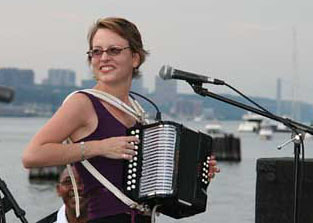
I know I have been very remiss in my blogging, and I hope to remedy that soon. In the meantime, I would like to share with you the joy of air guitar.
In order to clear my post-dissertation mind, I decided that the next topic calling out for research was competitive air instrument playing. If you have seen the moving Air Guitar Nation, you will probably know why. Actually, it fits very much with my interest in dance, gender, and the body because it is a (usually) masculine-identified kind of bodily performance, which is kind of a rarity in Anglo-American culture, at least.
I attended the German national air guitar championships last week to see what was what, and we observed some stimulating performances. Look at some pictures:
http://picasaweb.google.com/salsasydney/BerlinAirGuitar?authkey=Gv1sRgCIvHyI-6xsDGpAE&feat=directlink
Nearly half the competitors this year were women, which is a huge departure from past years when 0-1 women was the average number. Also, a huge number of them were from Hildesheim, which is not exactly a metropolis. It turned out that both of these unusual circumstances were due to the fact that a professor at the university there had been giving a course called "Aesthetics of air guitar" in which students had to come up with their own air guitar moves and try them out on each other weekly.
These students were pretty impressive. THey had clearly thought a lot about air guitar performance! So many in the audience felt the contestants were robbed when it was announced that this year's winner was once again Heart Buckboard, already a four-time winner. His performance was good, but in the round where everyone must improvise along with a song chosen by the jury, one of the Hildesheim women was clearly better. Also, another Hildesheimer, who performed a geek character who receives his guitar from heaven and is overtaken by it, forcing his body into strange and bizarre movements like the duck walk, was more creative. He came in third, a Berlin woman called Mel from Hell second (also an impressive performance, involving an introduction borrowed from Schlager, or schmaltzy German pop ballads). Buckboards will again be representing Germany at the International championships in Finland, which I'll be attending in August.
I am working on putting together my air character - airacter? - for next year.
Sunday, July 19, 2009

Saturday, July 4, 2009
Another web page
Hi people, and sorry to those who are receiving this twice.
Just wanted to let you know I also have another web page. It is kind of under construction still, but I also have a blog there (on issues basically unrelated to Dominican accordion music).
Visit me at: http://sydneyhutchinson.com/
Just wanted to let you know I also have another web page. It is kind of under construction still, but I also have a blog there (on issues basically unrelated to Dominican accordion music).
Visit me at: http://sydneyhutchinson.com/
Monday, March 16, 2009
Leipzig pictures
in case you like pictures to go with your stories, take a look here:
http://picasaweb.google.com/salsasydney/Leipzig#
http://picasaweb.google.com/salsasydney/Leipzig#
Travels in Leipzing, and tales of a hijacking
Hey guys, I wrote up these notes last October and I don't know why I didn't post them. I guess because I didn't finish writing up the exciting tales of Leipzig. But now I will post them here anyway for your reading pleasure. I hope to visit with you again soon about my adventures in Germany.
10/15/08
Recently we were in Leipzig for a conference, but for me the trip was at least as educational when it came to non-conferential matters. I don’t often take the opportunity to sight-see in Berlin but since it was a kind of mini-vacation for us, Maurice and I actually managed to look around a fair bit in Leipzig. Also, sitting at a desk writing is not usually a good way to experience German culture, in spite of the view of fall leaves backed by the DDR’s Alexanderplatz TV tower that I am looking at this very moment. In Leipzig I had a bit more opportunity for interaction.
The first thing I noticed when we arrived, after exiting the rather grand train station, was a couple of young men in out-of-the-ordinary attire. They had on black pants with very wide legs and a short coat with a widely spaced double row of buttons, sort of reminiscent of a sailor suit, together with a round-topped hat with a wide, flat brim, also in black.
Maurice informed me that this is the traditional outfit for apprentices here in Germany, particularly in the building trades. After learning their trade in school, they have the option of getting more practical experience by taking to the road for a few years in a sort of rite of passage. They travel from town to town, stopping in at the local shops to see if they can get any work. This tradition dates back to medieval times. They don’t have to wear the outfits, but the outfits announce their position and may help them to find work, food, or lodging, and they are a mark of pride. Also, apparently they get a lot of sex. A fringe benefit. We’re not sure if it also works for the women increasingly entering such trades.
Later on, we found more of these guys. We heard the sounds of a brass band while roaming the downtown area, and following our ears, came to a construction site. A new multi-story building was going up, and apparently the framework was just finished so a ceremony was being held. A kind of green tinseled cone that looked like some kind of Christmas decoration was being raised on the crane, and a bunch of those guys in the outfits were playing music in a circle. One had a bass drum; the others had the strangest kind of wind instruments I’d ever seen, with maybe eight or nine trumpet-shaped metal horns of different sizes pointing upwards. Later we saw some in the musical instrument museum but I can’t for the life of me remember what they’re called.
Some of the other sights we saw were of a more typical tourist nature. For instance, the church where Bach worked for a couple of decades. We even heard an organ concert there. Bach’s bones are also there, having been moved around a number of times, poor guy. Naturally, we also paid a visit to the musical instrument museum, which had an interesting collection of mechanical instruments and, of course, accordions. There has been a lot of classical music going on in this city for centuries. Mendelssohn also lived here, but we didn’t have time to visit his house.
Leipzig was the next-largest city in the DDR after Berlin, so it was home to some infamous installations of the Stasi. Of course, it was also the place where the peaceful uprisings that led to the end of the DDR and the Wall got started. This is another focus of Leipzig museums and something I particularly wanted to learn about. One museum was called the Forum for Contemporary History and had a sign in the front window reading “Warning: Contains history, which may cause reflection and lead to understanding,” or something to that effect. It was a free museum mostly dedicated to DDR history. It was really fascinating and well-presented, especially the collections relating to daily life. But we’d spent too long in the special exhibit, which had to do with ten scandals that changed the political outlook in post-war Germany, so we ran out of time and were only able to see a part of the permanent installations.
Another particularly interesting museum is the Stasi Museum housed in the Runde Ecke or “round corner,” the Stasi’s former headquarters. This place was impressive not so much for its displays, which consisted of lengthy typewritten notes attached to cardboard placards, but for its history. The building was occupied by concerned citizens of Leipzig just as the DDR was breathing its last. Apparently, as they went in they were asked by guards for their passcards, which they showed, and then proceeded to sit in and not leave for days, weeks, months, in order to prevent the Stasi from destroying any more of its records. This same citizens’ group created and runs the museum today. In the same building is an office in charge of keeping the remaining records of the Stasi open for public perusal.
The exhibits include various types of machines used to open envelopes and reseal them, record telephone conversations (onto recycled cassettes of popular music like Elvis, no less), take secret photos, record on the sly from one’s handbag. They include information on courses the Stasi gave in disguise, as well as suitcases with everything one needed to transform oneself into an inconspicuous “Arab” or “Construction Worker.” There was a perfectly-preserved 60s-70s style (the DDR didn’t seem to keep up with the latest trends in office furniture) Stasi man’s office. And at the end, an industrial-strength paper shredder complete with congealed bricks of pulp that used to be the records of someone’s life – or its end. The extent of their surveillance, the number of people they killed or whose lives they ruined in other, more devious, and less detectable ways was frightening. So the point was well-taken when a display on “Ostalgia” – nostalgia for East Germany – pointed out that the merchandise celebrating the DDR and the Stasi, now available in many tourist stores, is no joke, any more than it would be to sell Nazi memorabilia.
At the conference, I learned other kinds of things, many of a more immediately useful nature. For example, it turns out that at the end of an academic presentation in Germany, one is supposed to knock on the table rather than clap. The first time that happened, I thought we were voting on something. Not the case, I found out the next time I heard a paper and was the only one clapping.
I also began to understand the full extent of rivalries in German ethnomusicology. There are the old-school folks still doing some kind of comparative musicology (for those not in the know, this is the kind of thing that was new about 80-90 years ago), and there are those doing stuff related to cultural studies, popular music studies, etc – more the kind of thing we do in the US or UK today. Sadly, these two camps cannot seem to simply agree to disagree but have to actively agitate to prevent the others from ever getting any work done. The thing that really took the cake this time was when another ethnomusicologist actually hijacked Maurice’s chair! One of the people on his panel, the first to go one morning, hadn’t shown so the panel was to start a half-hour later than originally planned, in order to keep the papers to the times printed on the official program. But when we showed up in the morning, this other guy had already had the panelists start their papers! This was unfortunate for everyone, as about a dozen people showed up at the correct time to view the paper that had just finished - and then when Maurice tried to say something very politely, this guy totally cut him off! Well, this really pissed me off, but when I fumed about it later to another grad student attendee, she said, “These things just happen sometimes.” They do?? What kind of conferences does she normally go to, I wonder???
10/15/08
Recently we were in Leipzig for a conference, but for me the trip was at least as educational when it came to non-conferential matters. I don’t often take the opportunity to sight-see in Berlin but since it was a kind of mini-vacation for us, Maurice and I actually managed to look around a fair bit in Leipzig. Also, sitting at a desk writing is not usually a good way to experience German culture, in spite of the view of fall leaves backed by the DDR’s Alexanderplatz TV tower that I am looking at this very moment. In Leipzig I had a bit more opportunity for interaction.
The first thing I noticed when we arrived, after exiting the rather grand train station, was a couple of young men in out-of-the-ordinary attire. They had on black pants with very wide legs and a short coat with a widely spaced double row of buttons, sort of reminiscent of a sailor suit, together with a round-topped hat with a wide, flat brim, also in black.
Maurice informed me that this is the traditional outfit for apprentices here in Germany, particularly in the building trades. After learning their trade in school, they have the option of getting more practical experience by taking to the road for a few years in a sort of rite of passage. They travel from town to town, stopping in at the local shops to see if they can get any work. This tradition dates back to medieval times. They don’t have to wear the outfits, but the outfits announce their position and may help them to find work, food, or lodging, and they are a mark of pride. Also, apparently they get a lot of sex. A fringe benefit. We’re not sure if it also works for the women increasingly entering such trades.
Later on, we found more of these guys. We heard the sounds of a brass band while roaming the downtown area, and following our ears, came to a construction site. A new multi-story building was going up, and apparently the framework was just finished so a ceremony was being held. A kind of green tinseled cone that looked like some kind of Christmas decoration was being raised on the crane, and a bunch of those guys in the outfits were playing music in a circle. One had a bass drum; the others had the strangest kind of wind instruments I’d ever seen, with maybe eight or nine trumpet-shaped metal horns of different sizes pointing upwards. Later we saw some in the musical instrument museum but I can’t for the life of me remember what they’re called.
Some of the other sights we saw were of a more typical tourist nature. For instance, the church where Bach worked for a couple of decades. We even heard an organ concert there. Bach’s bones are also there, having been moved around a number of times, poor guy. Naturally, we also paid a visit to the musical instrument museum, which had an interesting collection of mechanical instruments and, of course, accordions. There has been a lot of classical music going on in this city for centuries. Mendelssohn also lived here, but we didn’t have time to visit his house.
Leipzig was the next-largest city in the DDR after Berlin, so it was home to some infamous installations of the Stasi. Of course, it was also the place where the peaceful uprisings that led to the end of the DDR and the Wall got started. This is another focus of Leipzig museums and something I particularly wanted to learn about. One museum was called the Forum for Contemporary History and had a sign in the front window reading “Warning: Contains history, which may cause reflection and lead to understanding,” or something to that effect. It was a free museum mostly dedicated to DDR history. It was really fascinating and well-presented, especially the collections relating to daily life. But we’d spent too long in the special exhibit, which had to do with ten scandals that changed the political outlook in post-war Germany, so we ran out of time and were only able to see a part of the permanent installations.
Another particularly interesting museum is the Stasi Museum housed in the Runde Ecke or “round corner,” the Stasi’s former headquarters. This place was impressive not so much for its displays, which consisted of lengthy typewritten notes attached to cardboard placards, but for its history. The building was occupied by concerned citizens of Leipzig just as the DDR was breathing its last. Apparently, as they went in they were asked by guards for their passcards, which they showed, and then proceeded to sit in and not leave for days, weeks, months, in order to prevent the Stasi from destroying any more of its records. This same citizens’ group created and runs the museum today. In the same building is an office in charge of keeping the remaining records of the Stasi open for public perusal.
The exhibits include various types of machines used to open envelopes and reseal them, record telephone conversations (onto recycled cassettes of popular music like Elvis, no less), take secret photos, record on the sly from one’s handbag. They include information on courses the Stasi gave in disguise, as well as suitcases with everything one needed to transform oneself into an inconspicuous “Arab” or “Construction Worker.” There was a perfectly-preserved 60s-70s style (the DDR didn’t seem to keep up with the latest trends in office furniture) Stasi man’s office. And at the end, an industrial-strength paper shredder complete with congealed bricks of pulp that used to be the records of someone’s life – or its end. The extent of their surveillance, the number of people they killed or whose lives they ruined in other, more devious, and less detectable ways was frightening. So the point was well-taken when a display on “Ostalgia” – nostalgia for East Germany – pointed out that the merchandise celebrating the DDR and the Stasi, now available in many tourist stores, is no joke, any more than it would be to sell Nazi memorabilia.
At the conference, I learned other kinds of things, many of a more immediately useful nature. For example, it turns out that at the end of an academic presentation in Germany, one is supposed to knock on the table rather than clap. The first time that happened, I thought we were voting on something. Not the case, I found out the next time I heard a paper and was the only one clapping.
I also began to understand the full extent of rivalries in German ethnomusicology. There are the old-school folks still doing some kind of comparative musicology (for those not in the know, this is the kind of thing that was new about 80-90 years ago), and there are those doing stuff related to cultural studies, popular music studies, etc – more the kind of thing we do in the US or UK today. Sadly, these two camps cannot seem to simply agree to disagree but have to actively agitate to prevent the others from ever getting any work done. The thing that really took the cake this time was when another ethnomusicologist actually hijacked Maurice’s chair! One of the people on his panel, the first to go one morning, hadn’t shown so the panel was to start a half-hour later than originally planned, in order to keep the papers to the times printed on the official program. But when we showed up in the morning, this other guy had already had the panelists start their papers! This was unfortunate for everyone, as about a dozen people showed up at the correct time to view the paper that had just finished - and then when Maurice tried to say something very politely, this guy totally cut him off! Well, this really pissed me off, but when I fumed about it later to another grad student attendee, she said, “These things just happen sometimes.” They do?? What kind of conferences does she normally go to, I wonder???
Tuesday, June 3, 2008
Pictures from Stockholm
Last week we were in Stockholm for a conference. Check out the photos.
http://picasaweb.google.com/salsasydney/MayInStockholm
http://picasaweb.google.com/salsasydney/MayInStockholm
Only in Germany...
Long time no post! Busy with my dissertation, sorry about that, but at long last here is a little list I made for you all. To be added to in the future as necessary.
Only in Germany:
1. American food in grocery store’s exotic foods section. Karstadt, a high-priced German grocery and department store has several shelves marked “American food” located in their exotic foods section, right between Mexico and Thailand. Some of the items found on this shelf include: Arm & Hammer baking soda, jalapeño pepper jelly, pancake mix, artificial maple syrup, and Marshmallow Fluff – in both regular and strawberry flavors. This is certainly exotic enough for the label, as I don’t think I have seen this frightening pink product even in the US!
2. The party streetcar. East Berlin is known for its bright yellow electric trams, which travel down the middle of many of the busiest avenues, a fourth means of public transportation. The other day we had just stepped off one, and were waiting to cross Prenzlauer Allee to go to my friendly second-hand English bookstore, when I heard a noise. This noise sounded strangely like a party, but appeared to be traveling towards us from the left. I looked up and discovered… the Party Tram! Full of drunken young Germans loudly singing in chorus, decorated with disco balls and flashing lights, and not yellow but with a festive purple and blue outer wrapping. Apparently, you can rent this thing out and have it drive you and your friends around the streets of Berlin all night as you get completely wasted.
3. “Bistro Firstaid” – this is the actual name of a fast-food restaurant on Schoenhauser Allee. Would YOU want to eat there?
4. Speakeasies. You thought these disappeared after Prohibition, but they’re still operational here in Berlin. Nameless, temporary, unlicensed pubs, they are open on an irregular basis until discovered by the authorities and shut down, but in between they usually have a few months of good business. To get in you need to know the address and the secret passwood. A Spanish friend told me of one called Mittwoch (Wednesday), possibly because it’s only open on that day. Can’t wait to learn the secret word…
5. Bureaucracy. This, and forms needing to be filled out, are a German specialty. Many of the world’s forests are currently being cut down merely to serve German bureaucratic needs. The size of the bureaucratic system is inversely proportional to the amount of work they produce and number of hours they work. Two examples will suffice.
First, I tried to get a library card to use the collections of the Ibero-American Institute. It is the largest library in Europe on Latin America, so it would of course be nice if I could use it. It is part of the same system as the national library, for which I already have a card, so it didn’t seem that it would be such a big deal. I even bothered to go to my local bureaucracy supplier to get a form showing where in Berlin I live and since when, so I’d be totally legit. Armed with this and my passport, I went and filled out a couple of forms for good measure… only to be told that with no visa I couldn’t get a card. Pointing out that I already had a card from the national library didn’t help – they just told me that “the national library has a big legal department, and we don’t.” Apparently they are afraid that I am a literary terrorist who might kidnap their books and take them out of the country. Result: I can look at any book in Germany that I want to, except for those that have to do with my area of expertise.
Well, I needed to get a German visa anyway, so then I proceeded to look into how this might be accomplished. I am just now recovering from the process. It took approximately one month from my communication with a German bureaucrat to when I was able to actually get together all of the paperwork she requested of me. At that point, it was just three working days before I was to leave for a meeting in Sweden, and I couldn’t leave the country without a visa ensuring I’d be able to return. One of these days was wasted in a health insurance office trying unsuccessfully to get a paper stating, in German, that I was insured. This, however, could not be accomplished because (a) my letter stating I was insured worldwide was in English, and (b) they didn’t have the time to have their legal department review Aetna’s entire policy brochure. So the next day we decided to just take our chances and visit the foreigners’ office with the stack of papers I already had. We were in line at 8 AM, but by the time we got to the front of it, we were told they were already closed for student applicants. They had opened at 7 AM, so apparently they were open for one hour only that day. The woman told us, “Come back tomorrow. But we might be on strike.”
As it turned out, they didn’t strike, we were in line at 6:50, and several waiting rooms later, at 8:30 I had a visa. Our plane left at 9:25. We got to the airport at 9:10. But in the end, we made it to Sweden, and I am no longer an illegal alien! (Put it down as a few months of participant observation.)
Only in Germany:
1. American food in grocery store’s exotic foods section. Karstadt, a high-priced German grocery and department store has several shelves marked “American food” located in their exotic foods section, right between Mexico and Thailand. Some of the items found on this shelf include: Arm & Hammer baking soda, jalapeño pepper jelly, pancake mix, artificial maple syrup, and Marshmallow Fluff – in both regular and strawberry flavors. This is certainly exotic enough for the label, as I don’t think I have seen this frightening pink product even in the US!
2. The party streetcar. East Berlin is known for its bright yellow electric trams, which travel down the middle of many of the busiest avenues, a fourth means of public transportation. The other day we had just stepped off one, and were waiting to cross Prenzlauer Allee to go to my friendly second-hand English bookstore, when I heard a noise. This noise sounded strangely like a party, but appeared to be traveling towards us from the left. I looked up and discovered… the Party Tram! Full of drunken young Germans loudly singing in chorus, decorated with disco balls and flashing lights, and not yellow but with a festive purple and blue outer wrapping. Apparently, you can rent this thing out and have it drive you and your friends around the streets of Berlin all night as you get completely wasted.
3. “Bistro Firstaid” – this is the actual name of a fast-food restaurant on Schoenhauser Allee. Would YOU want to eat there?
4. Speakeasies. You thought these disappeared after Prohibition, but they’re still operational here in Berlin. Nameless, temporary, unlicensed pubs, they are open on an irregular basis until discovered by the authorities and shut down, but in between they usually have a few months of good business. To get in you need to know the address and the secret passwood. A Spanish friend told me of one called Mittwoch (Wednesday), possibly because it’s only open on that day. Can’t wait to learn the secret word…
5. Bureaucracy. This, and forms needing to be filled out, are a German specialty. Many of the world’s forests are currently being cut down merely to serve German bureaucratic needs. The size of the bureaucratic system is inversely proportional to the amount of work they produce and number of hours they work. Two examples will suffice.
First, I tried to get a library card to use the collections of the Ibero-American Institute. It is the largest library in Europe on Latin America, so it would of course be nice if I could use it. It is part of the same system as the national library, for which I already have a card, so it didn’t seem that it would be such a big deal. I even bothered to go to my local bureaucracy supplier to get a form showing where in Berlin I live and since when, so I’d be totally legit. Armed with this and my passport, I went and filled out a couple of forms for good measure… only to be told that with no visa I couldn’t get a card. Pointing out that I already had a card from the national library didn’t help – they just told me that “the national library has a big legal department, and we don’t.” Apparently they are afraid that I am a literary terrorist who might kidnap their books and take them out of the country. Result: I can look at any book in Germany that I want to, except for those that have to do with my area of expertise.
Well, I needed to get a German visa anyway, so then I proceeded to look into how this might be accomplished. I am just now recovering from the process. It took approximately one month from my communication with a German bureaucrat to when I was able to actually get together all of the paperwork she requested of me. At that point, it was just three working days before I was to leave for a meeting in Sweden, and I couldn’t leave the country without a visa ensuring I’d be able to return. One of these days was wasted in a health insurance office trying unsuccessfully to get a paper stating, in German, that I was insured. This, however, could not be accomplished because (a) my letter stating I was insured worldwide was in English, and (b) they didn’t have the time to have their legal department review Aetna’s entire policy brochure. So the next day we decided to just take our chances and visit the foreigners’ office with the stack of papers I already had. We were in line at 8 AM, but by the time we got to the front of it, we were told they were already closed for student applicants. They had opened at 7 AM, so apparently they were open for one hour only that day. The woman told us, “Come back tomorrow. But we might be on strike.”
As it turned out, they didn’t strike, we were in line at 6:50, and several waiting rooms later, at 8:30 I had a visa. Our plane left at 9:25. We got to the airport at 9:10. But in the end, we made it to Sweden, and I am no longer an illegal alien! (Put it down as a few months of participant observation.)
Sunday, February 17, 2008
Latest photos
some photos here for you to see: my dad's visit to Berlin, our visit to Hannover, and some other stuff around here.
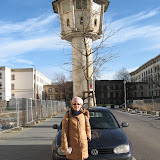 |
| Latest Berlin pics! |
Subscribe to:
Posts (Atom)